Live Today and Ten Years From Now at the Same Time: Designing Time with Three Horizons Thinking
The busier today gets, the less we invest in the future. Learn the Three Horizons framework successful people use to balance time across today, the next few years, and a decade ahead.
Busyness Eats Your Future—Surviving Today Isn't Enough
On your busiest days, investment in the future is the first thing to fall. Meetings, replies, imminent deadlines—as short-term load piles up, tasks that are "important in ten years but not required today" quietly disappear. This is one of the biggest reasons so many people look back five or ten years later and feel, "Nothing really changed."
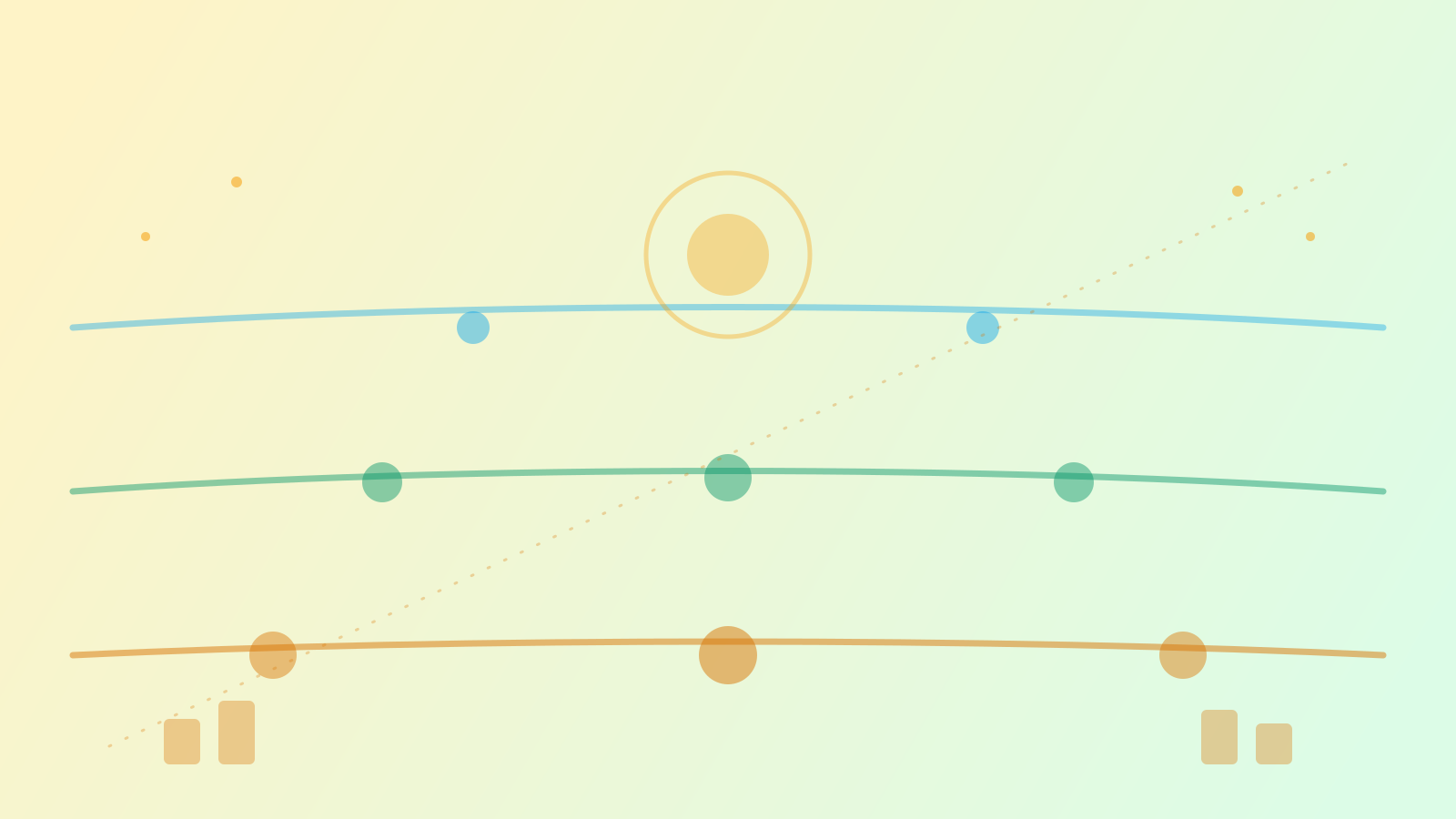
McKinsey & Company's Three Horizons framework, originally designed for corporate innovation strategy, helps companies run today's business while growing tomorrow's. The same model maps remarkably well onto personal time management. It divides attention into three layers: Horizon 1 (today to one year), Horizon 2 (one to three years), and Horizon 3 (three to ten years and beyond), and asks you to allocate time intentionally across all three.
People who pour everything into just one horizon produce short-term results but stall within five years. People who live only in the distant horizon cannot keep today functioning. What successful people share is the ability to live across three time frames simultaneously.
Horizon 1—Protecting the Reliable Results of Today and This Month
Horizon 1 covers daily operations, monthly goals, and the quality of your current work. Neglect it, and you lose the ground you stand on tomorrow.
Two keys dominate this layer: standardization and shortening. Rather than rebuilding recurring tasks from scratch, turn them into templates and routines that demand minimal mental energy. Fix headers for recurring reports, run weekly reviews with the same set of questions—small patternizations compound into real relief.
The shortening key is to keep asking, "Does this really have to happen today?" Many people confuse non-urgent tasks with urgent ones. Spending ten seconds each morning asking, "Which of these would not hurt if it slipped to tomorrow?" can lighten Horizon 1 load by twenty to thirty percent.
Horizon 2—Investing in Possibilities One to Three Years Ahead
Horizon 2 is investment in futures just beyond the straight extension of today—new skills, side projects, new relationships, cross-disciplinary learning.
The hard part of Horizon 2 is that no one scolds you if you skip it today. No boss prompts you, no customer complains. Exactly for that reason, it requires intentional time blocking.
A practical habit is to put at least two hours per week on your calendar, dedicated to Horizon 2. Place it alongside "work" and "rest" as "time invested in my future self." For instance, Saturday 9–11 a.m.: read a book in a field you are just beginning to explore, talk with someone from an industry you have never touched, update your portfolio.
Those two hours become 104 hours a year and 312 hours across three years—close to forty working days of focused learning. That quietly protected slice is enough to reshape the range of your career three years out.
Horizon 3—Asking Who You Want to Be in Ten Years
Horizon 3 concerns directional questions: five or ten years from now, where do you want to be, with whom, doing what? This is not a detailed plan; it is values, aspirations, and meaning.
In daily life, there is almost no time to think about Horizon 3. That is precisely why deliberate pauses are essential. A practical rhythm is to set aside half a day once a quarter and sit with these three questions:
1. Ten years from now, who do I want to spend my time with? 2. Ten years from now, through what kind of work do I want to contribute? 3. Seen from that future, what should I start—and what should I stop—today?
What matters is staying with the questions, not producing a final answer. Your ten-year vision will shift each time you revisit it. Those shifts themselves become a record of your inner growth.
A Thought on a Stuck Evening After Work
One weekday night, I was walking home after a day where the work had not finished and the mood was heavy. As the window of the train reflected my face, a quiet question surfaced: "How does what I'm doing now connect to the me of ten years from now?" Honestly, no clear answer came.
Once home, I opened my notebook and wrote a single line: "I've been running only Horizon 1, and Horizons 2 and 3 are empty." Writing it down clarified something I didn't know I knew. The weight I had been feeling was not busyness itself, but the fact that busyness was eroding the space where the future could grow.
Starting the following week, I blocked Saturday 9–11 a.m. as "time invested in my future self." For the first few weeks, just holding those two hours felt slightly guilty. After two months, though, those two hours became the lightest part of my week. The day-to-day pressure didn't vanish, but having three time horizons inside me quietly eased the suffocation of the daily grind.
A "Time Portfolio" for Making the Balance Visible
Once you see where your hours actually go across the three horizons, the imbalance becomes obvious. A simple method: go through one week of your calendar and color-code every hour by Horizon 1, 2, or 3.
Most people discover, uncomfortably, that Horizon 1 absorbs over 90 percent. Balance varies by person, but many long-term performers consciously aim for roughly Horizon 1 = 70–80%, Horizon 2 = 15–20%, Horizon 3 = 5–10%.
Reviewing this portfolio once at the end of each month is enough to prevent quiet, long-term drift. Numbers make the invisible leakage of time finally visible.
A Fifteen-Minute Weekly "Horizon Review" to Keep Everything Aligned
Finally, here is a concrete weekly ritual. Spend fifteen minutes at the weekend on these three steps.
First, roughly note which horizon received your time this week: "Horizon 1: ~90%, Horizon 2: ~5%, Horizon 3: ~5%." Subjective sense is fine.
Second, pick one specific slot next week for Horizon 2 and one for Horizon 3. Horizon 2 might be a two-hour block; Horizon 3 might be thirty minutes with a single question.
Third, compare Horizon 3 clarity now with three months ago. Your answers may not have changed—but if the questions themselves are sharper, your thinking has advanced.
Life is not lived only today, nor only in some future ten-year point. It is lived in both at once. Hitting today's deadlines while quietly planting seeds for the future—this double stance is what reshapes the landscape a few years out. Tomorrow morning, open your calendar and block two hours somewhere this week for "Horizon 2." Those two hours are what your three-years-from-now self is made of.
About the Author
Success Mindsets Editorial TeamWe share proven success mindsets and strategies in a way that is easy to understand and applicable to everyday life.
View author profile →Related Articles
Chance Beats the Plan: How Successful People Use Planned Happenstance to Shape Their Careers
Why Grit Beats Talent: A Science-Based Guide to Cultivating Long-Term Perseverance
Those Who Remember Names Get Chosen: Mastering the Art of Name Memory
Deciding from Your 80-Year-Old Self: The Regret Minimization Framework for Clearer Goals