Maximize Productivity with Weekly Energy Mapping—The Art of Day-by-Day Performance Design Practiced by Successful People
Can't focus on Monday but surprisingly productive on Friday? Learn how to visualize your energy patterns by day of the week and boost productivity through optimal task placement.
Why Day-by-Day Energy Management Matters
Most professionals are aware of energy fluctuations within a single day—high focus in the morning, a dip in the afternoon—but pay almost no attention to energy variations across days of the week. However, a study published by a research team at the University of Pennsylvania in 2019 showed that performance variations within a week can reach up to 35%. This means the same person working on the same task can produce results that differ by more than a third depending on the day.
The primary cause of this variation lies in the interaction between biological rhythms and social rhythms. Weekend rest patterns, Monday's re-entry stress, midweek accumulated fatigue, and Friday's psychological sense of release—these factors combine to create day-specific energy patterns. The difference between successful people and others lies in whether they view this inevitable fluctuation as an enemy or transform it into an ally.
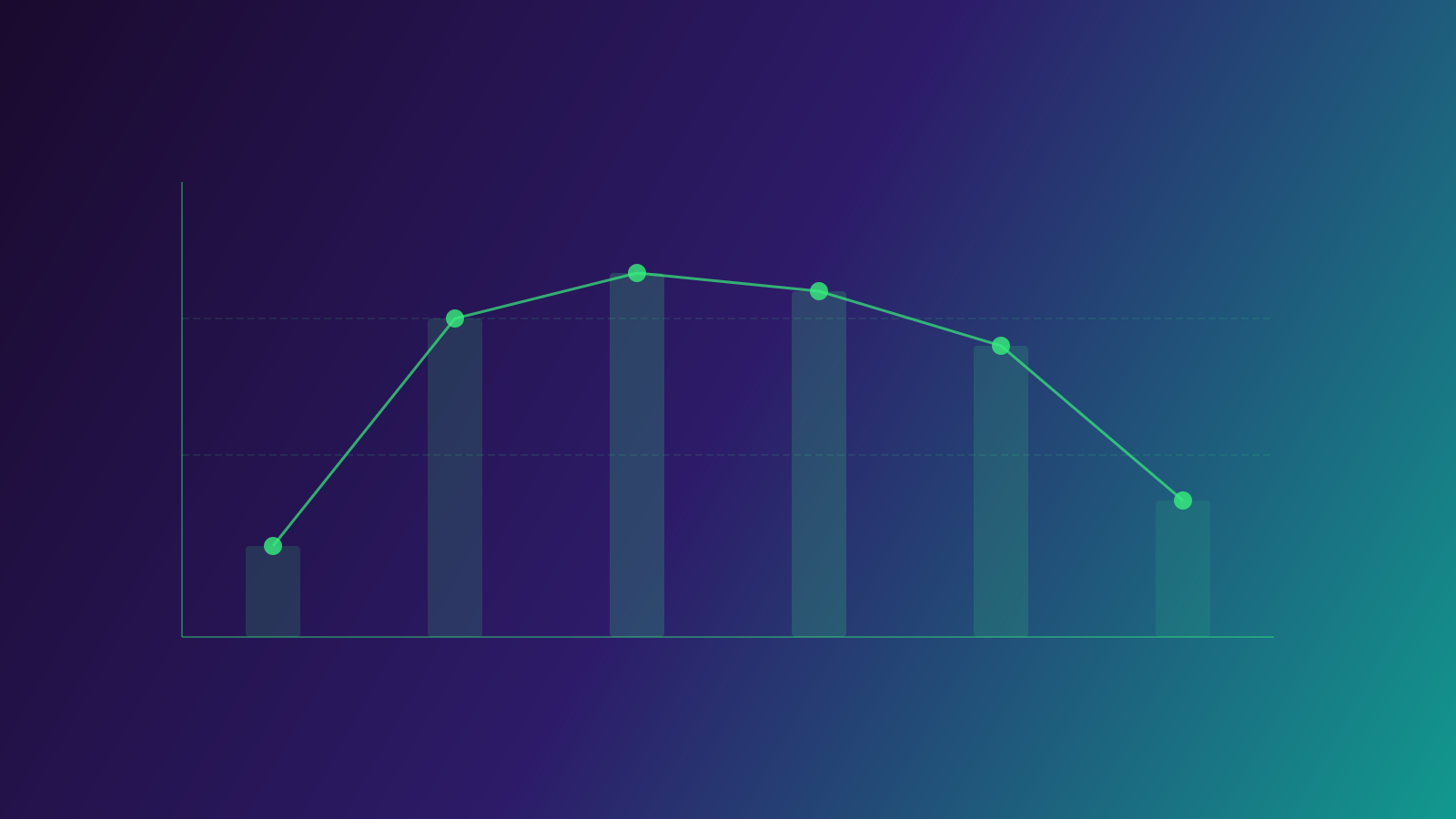
A Weekly Energy Map is a method of visualizing your day-by-day energy patterns and optimally placing tasks accordingly. This is not mere schedule management but what should be called "performance design" based on your biological rhythms. Just as top athletes peak their conditioning for game day, business professionals can produce greater results with the same effort by aligning their most important work with their peak energy days.
Scientifically Discovering Your Day-by-Day Energy Patterns
To accurately grasp your weekly energy pattern, you need a data-driven approach rather than relying on subjective feelings alone. Try implementing the following "Two-Week Energy Log."
Three times daily (10 AM, 2 PM, 6 PM), rate the following four items on a 10-point scale. First, "Focus"—how deeply you can immerse yourself in analytical thinking. Second, "Creativity"—how readily new ideas and solutions flow. Third, "Interpersonal Energy"—how motivated you feel to communicate with others. Fourth, "Physical Energy"—your level of physical vitality.
Once you have collected two weeks of data, calculate the average for each item by day of the week. Visualizing this as a radar chart or heat map reveals your unique "Weekly Energy Curve." For example, you might discover that Tuesday mornings yield peak focus while Wednesday afternoons are your creativity peak.
As a supplementary note, chronobiology research at the University of California found that approximately 65% of people are "Midweek Peakers" who reach their best performance between Tuesday and Thursday, about 20% are "Monday Starters" who perform highest on Mondays, and the remaining 15% are "Friday Finishers" whose energy rises on Fridays. Knowing which type you belong to is the starting point for effective energy map design.
The 3-Zone Placement Method—Practical Day-by-Day Task Optimization
Once your energy map is complete, the next step is optimal task placement. Here is a detailed explanation of the "3-Zone Placement Method" practiced by successful people.
On "High Zone" days, concentrate your most cognitively demanding tasks. These include strategic planning, important presentations, complex problem analysis, and new project design. Former Google Chief People Officer Laszlo Bock noted in his book that "performing your most important work during your highest-energy periods can more than double productivity." During High Zone periods, turn off notifications, block meetings, and create an environment that allows deep immersion.
On "Middle Zone" days, place communication-centered tasks. Regular meetings, one-on-one sessions, team brainstorming, and email correspondence are well suited for these days. These tasks can be adequately handled with moderate interpersonal energy, and collaboration with others can actually help replenish your energy.
On "Low Zone" days, assign routine tasks. Expense reports, file organization, meeting minutes, and next week's schedule adjustments fit perfectly. The key is not to view Low Zone days as "wasted days." Instead, actively use them as "preparation and recovery days" to deliver maximum performance during the following week's High Zone.
For example, one management consultant designs their week as follows: Monday (Middle Zone) is devoted to team meetings and client communications; Tuesday and Wednesday (High Zone) are reserved for strategy development and proposal writing; Thursday (Middle Zone) handles client meetings and feedback; and Friday (Low Zone) is used for reflection and next-week preparation. Since adopting this arrangement, the quality of their proposals noticeably improved, and client approval rates increased by 40%.
Strategically Leveraging Monday and Friday
In a Weekly Energy Map, the use of Monday and Friday is particularly crucial. Most people pass through these two days unconsciously, yet how you design them determines the productivity of your entire week.
Secure Monday morning as "Weekly Planning Time." Specifically, use 90 minutes in the morning for three activities. First, narrow down your Most Important Tasks (MITs) for the week to three or fewer. Second, place each task on the optimal day based on your energy map. Third, identify potential obstacles and devise countermeasures in advance. This "Monday morning 90-minute investment" dramatically elevates performance for the entire week.
An internal Microsoft survey found that employees who habitually create weekly plans on Monday mornings achieve 28% higher weekly goal completion rates compared to those who do not. This strategy is especially effective for people whose Monday energy is low. Planning does not require intense focus, yet it clarifies the direction for the entire week, enabling decisive action from Tuesday onward.
Friday, on the other hand, should be designed as a "reflection and recharge day." Use the final hour of the afternoon to review the week's accomplishments, organize tasks carrying over to next week, and verify the accuracy of your energy map. Additionally, intentionally schedule "loose tasks" on Friday afternoons—reading interesting articles, researching industry trends, jotting down future ideas—to stimulate intellectual curiosity while facilitating a smooth transition into the weekend.
Applying Weekly Energy Maps Across Teams
Weekly Energy Maps deliver even greater impact when shared across an entire team rather than used individually. When all team members share their energy patterns, meeting scheduling and project planning fundamentally change.
For instance, if the entire team's High Zone concentrates on Tuesday, scheduling a regular meeting on Tuesday is a significant waste. That time should be used for deep individual focus work, with meetings moved to Middle Zone days. In practice, when one IT company's team adopted this approach, project delivery speed improved by 25% and member satisfaction scores rose substantially.
The team implementation steps are as follows. First, each member takes a two-week Energy Log to understand their personal patterns. Next, compile the team's energy maps into one overview and identify common High Zones and Low Zones. Then, place meetings and collaborative work during the team's collective Middle Zone. Finally, conduct a monthly team retrospective to fine-tune the arrangement.
For leaders and managers, respecting members' Low Zones is particularly important. Assigning urgent requests or high-load tasks on someone's Low Zone day negatively impacts not only their performance but also their motivation. When a culture of sharing energy maps takes root, rational conversations about "why this task is being assigned today" emerge naturally, elevating the entire team's performance.
Building Systems to Continuously Evolve Your Weekly Energy Map
A Weekly Energy Map is not something you create once and forget. Because human energy patterns change with seasons, age, living circumstances, and project phases, regular updates are essential.
To build an evolution system, incorporate three "Review Cycles." First, a "Weekly Review"—every Friday, spend five minutes reflecting on whether this week's task placement was optimal. Second, a "Monthly Review"—at month's end, spend 30 minutes re-measuring your Energy Log and checking for pattern changes. Third, a "Quarterly Review"—every three months, redesign your entire energy map to account for major changes in work or life circumstances.
The concept of "Energy Buffers" is also crucial. Avoid packing each day too tightly; reserve 15-30 minutes of spare capacity. This prevents your entire energy map from collapsing when unexpected urgent tasks arise. Think of buffers not as "empty space" but as "structural reinforcement that increases your map's durability."
Finally, quantitatively measuring the effectiveness of your energy map is important. Track weekly completed task counts, critical task achievement rates, and subjective satisfaction scores, then visualize how much improvement occurred before and after map implementation. When you can confirm results through numbers, motivation to continue using the map persists, leading to sustained long-term productivity gains.
By making day-by-day energy your ally, you can generate greater results with the same effort. Start your two-week Energy Log today and design your ultimate weekly schedule.
About the Author
Success Mindsets Editorial TeamWe share proven success mindsets and strategies in a way that is easy to understand and applicable to everyday life.
View author profile →Related Articles
Autonomy as the Ultimate Motivator—How Successful People Sustain Motivation Through the Power of Self-Direction
The Power of Strategic Quitting—Why Successful People Improve Their Lives by Knowing When to Walk Away
Recover Before You Burn Out—How Successful People Design Intentional Recovery Cycles for Sustained Performance
The Power of Intellectual Humility — How Admitting You Might Be Wrong Accelerates Growth